
OUR SOLUTIONS
When a large number of individuals report having suffered losses related to matters involving cryptocurrencies, trading, or financial and interbank services offered by foreign trusts, VeritexData can assist in organizing, analyzing, and reconstructing the available documentary and digital information.
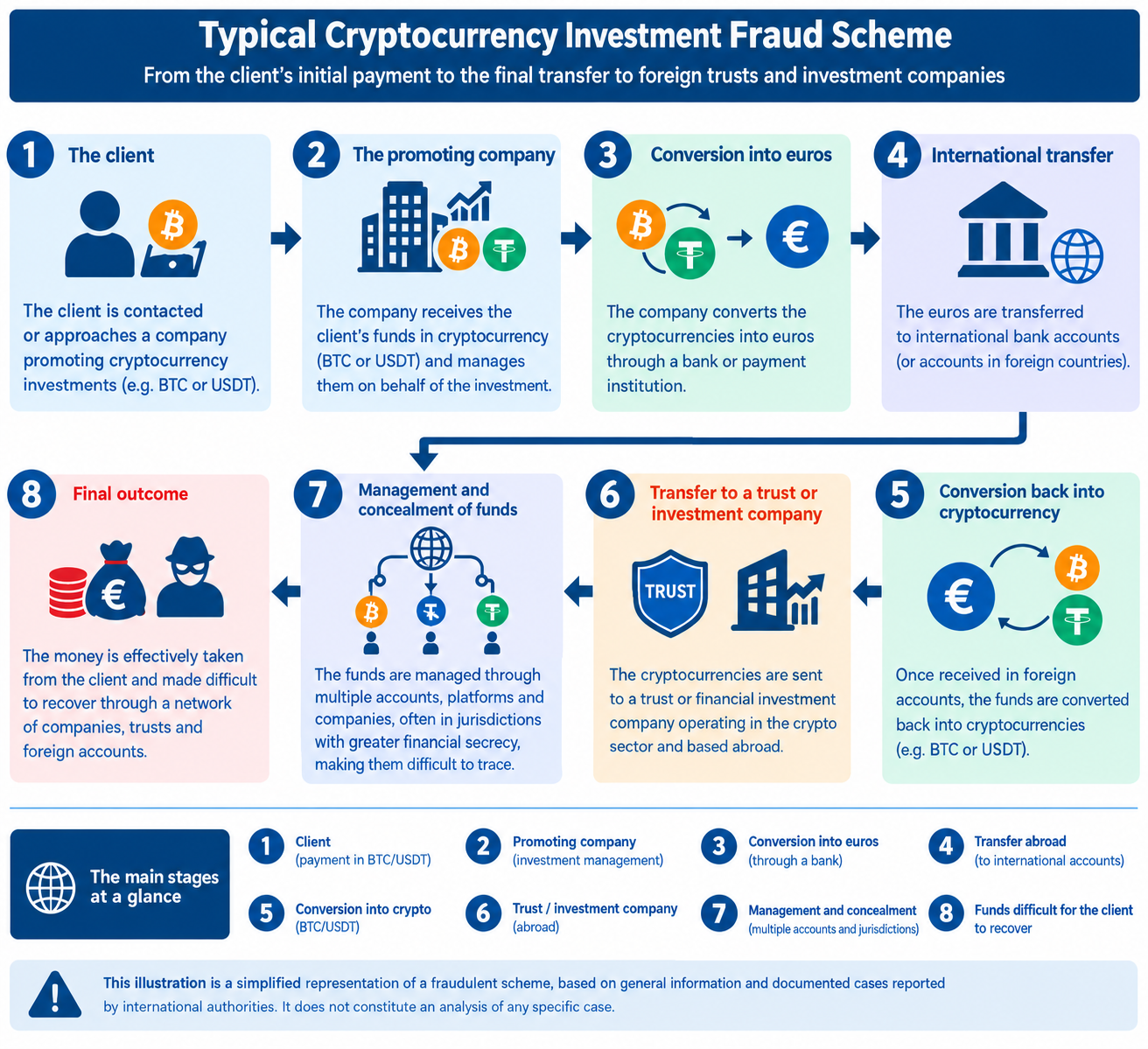
The service aims to provide a structured, traceable, and accessible framework of information for the affected individuals and their appointed professionals, including the following:
- Collection and classification of documentation provided by the participants.
- Verification and cross-referencing of contracts, receipts, account statements, and communications.
- Chronological reconstruction of events and financial relationships.
- Analysis of financial flows and cryptocurrency transactions.
- Crypto-tracing of movements recorded on the blockchain.
- OSINT (Open-Source Intelligence) analysis of information available from public sources.
- Identification of inconsistencies and missing data.
- Organization of digital evidence and references to sources.
- Comparison of individual positions to identify commonalities and differences.
- Preparation of a comprehensive report detailing the findings, sources consulted, and the scope/limitations of the verification process.
This work may pertain to matters involving cryptocurrency investments, trading platforms, arbitrage, mining operations, digital wallets, exchanges, and financial or interbank services linked to foreign trusts and companies.
VeritexData provides informational and documentary support designed to make data more organized, comparable, and verifiable for the benefit of the participants and their appointed professionals. This analysis does not constitute legal advice, nor does it guarantee the recovery of funds or the outcome of any collective legal action.
An Overview of Our Services
1. Documentary Verification: What Is Being Checked?
2. Digital Metadata: What Do Files Tell Us?
3. Verification of Bitcoin Transactions: How Do You Read a Blockchain Record?
A Methodology Based on Clarity and Transparency
Crypto Tracing, OSINT and Document Comparison: Reconstructing Information Methodically
4. Crypto Tracing: Reconstructing Cryptocurrency Movements
5. OSINT: How Can Information Available Online Be Verified?
6. Document Comparison: Identifying Inconsistencies and Differences
Data, Sources and Corroborating Evidence: A Transparent Method
From Fact Reconstruction to Due Diligence: Organising and Verifying Information
7. Chronological Reconstruction of Events: Putting Information in Order
8. Digital Evidence: File Preservation, Integrity and Traceability
9. Documentary Due Diligence: Verifying Information Before Making Decisions
10. From Data to a Documentary Report: Making the Findings Understandable
The VeritexData Method: Clarity, Corroborating Evidence and Stated Limitations
1. Purpose and Methodological Framework of the Analysis
2. The Most Robust Quantitative Evidence: Payment Fraud
3. Cryptocurrency-Related Fraud: The Evolution of Risks Documented by European Authorities
– 2016–2021: An Evolving Phenomenon
– 2022–2025: Cross-Border Fraud and Increasing Operational Complexity
4. Official Data on Online Fraud: How Widespread Is the Phenomenon?
5. Evolution of Documented Modus Operandi
6. The Challenge of the Cross-Border Dimension
7. Conclusions: What We Can State Without Overinterpreting the Data