
VeritexData | Analysis, Verification and Information Reconstruction
Documentary Verification, Digital Metadata and Blockchain Analysis: Turning Data into Verifiable Information
A structured approach to examining documents, digital files and blockchain records, helping distinguish verifiable information from assumptions and unresolved questions.
VeritexData — Analysis, Verification and Information Reconstruction
When an individual or business needs to understand a complex situation, the available material often consists of documents, communications, digital files or transaction records which, taken individually, are insufficient to establish a clear picture of what occurred.
VeritexData examines, cross-references and organises the available information in a structured and comprehensible manner, distinguishing verifiable data from assumptions and matters requiring further investigation.
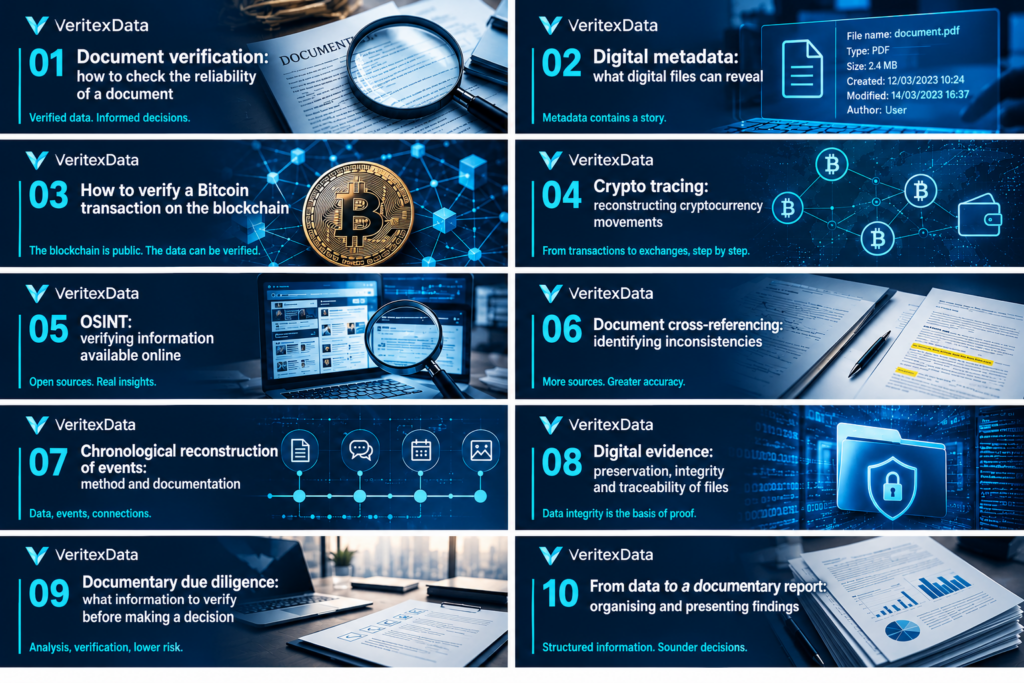
The objective is to provide clients with a clearer, better-documented informational framework, enabling them to understand the circumstances and make informed decisions regarding potential subsequent steps.
Documentary Verification: What Is Examined?
Documentary verification involves analysing documents supplied by the client or obtained from accessible sources relevant to the engagement.
Depending on the material available, the work may include:
- Examining the contents of documents.
- Comparing different versions of the same document.
- Checking the consistency of dates, amounts, names and references.
- Identifying discrepancies, inconsistencies and missing information.
- Cross-referencing documents, communications and other available corroborating material obtained through research activities.
What does the client receive?
Depending on the scope of the engagement, the client may receive a structured account of the documents examined, an indication of the corroborating information identified and a record of any discrepancies detected, together with references to the sources consulted.
It is important to clarify that examining a document does not, in itself, constitute certification of its authenticity. Where the document’s provenance or integrity cannot be independently established, this limitation is expressly distinguished from findings that have been verified.
Documents or other materials whose authenticity, provenance or integrity remain uncertain may be identified as requiring further examination, potentially by the competent judicial authorities or appropriately qualified professionals.
Digital Metadata: What Can Digital Files Reveal?
Digital files may contain technical information beyond the text or images visible to the user. Such information is commonly referred to as metadata.
Depending on the file format and the manner in which the file was created, processed or preserved, metadata may include the file name, format, size, certain technical timestamps, the software used or other available properties.
Metadata analysis can help clarify the technical characteristics of a digital document and facilitate comparison with other elements of an investigation or documentary reconstruction.
The work may include:
- Examining the technical properties of available files.
- Comparing metadata across different files.
- Assessing consistency between metadata, document content and the chronology reported.
- Identifying technical limitations, anomalies and unavailable information.
Metadata alone, however, does not conclusively establish the actual date of creation, the identity of the author or the absence of subsequent alterations. Metadata can be modified, removed or regenerated by different software applications and systems. Accordingly, it must be interpreted in conjunction with other available evidence and corroborating information.
What does the client receive?
A clear and accessible account of the digital properties examined, the correspondences identified and any anomalies detected, without attributing to technical data a probative significance beyond what those data can reasonably establish.
Verification of Bitcoin Transactions: How Is a Blockchain Record Examined?
Bitcoin transactions are recorded on a public blockchain and can be examined using dedicated blockchain explorers and analytical tools.
Where a client needs to verify a cryptocurrency transaction, the analysis may begin with a transaction identifier, commonly known as a transaction ID or TXID, a blockchain address or other available transaction-related information.
The analysis may include:
- Locating the transaction using its TXID.
- Examining the blockchain addresses involved.
- Verifying the recorded amount and the crypto-asset transferred.
- Examining the transaction timestamp and confirmation status.
- Comparing the blockchain record with the documentation supplied by the client.
- Reconstructing transfers between addresses, to the extent permitted by the available data.
A Practical Example
A client states that Bitcoin was transferred from an account under their control to a specified blockchain address.
The analysis may establish whether the blockchain records a transaction consistent with the stated amount, destination address and relevant period.
Where exchange records, transaction receipts or communications relating to the operation are also available, these materials may be cross-referenced to develop a more comprehensive reconstruction.
Three distinct aspects must nevertheless be distinguished:
- The transaction itself. What is actually recorded on the blockchain, including the relevant transaction details and transfers between addresses.
- The link to an account. Whether exchange records or other reliable documentation establish a connection between the transaction and a specific customer account.
- The identity of the address holder. Whether independent and sufficiently reliable documentation establishes a connection between a blockchain address and a particular individual or organisation.
The blockchain, by itself, generally does not identify the real-world owner or controller of a particular address. Furthermore, the existence of a transaction does not automatically establish the commercial or legal purpose of the transfer, the existence of a contractual relationship or the liability of any particular person.
For these reasons, publicly available blockchain data must be examined alongside other available sources, with a clear distinction between matters that have been verified and matters that remain to be established.
A Methodology Based on Clarity and Transparency
Verifying a document, examining the metadata of a digital file or analysing a blockchain transaction involves working with different sources, each with its own characteristics, evidential value and limitations.
The value of this work lies in bringing those sources together in a structured and traceable manner, making the analytical process understandable and enabling the client to distinguish between:
- Findings directly supported by the material examined.
- Information corroborated by multiple independent sources.
- Discrepancies requiring further investigation.
- Conclusions that cannot reliably be reached on the basis of the available data.
VeritexData promotes an approach grounded in source documentation, methodological transparency and the accurate presentation of findings.
A useful verification requires more than identifying a data point: it requires understanding its origin, comparing it with other available information and stating precisely what it establishes — and what it does not establish.
Further Information
For further information about our activities and collaboration arrangements, please visit the official website: