
THE EVOLUTION OF CRYPTOCURRENCY-RELATED, FINANCIAL AND BANKING FRAUD WITHIN THE EUROPEAN UNION
1. Purpose and Methodological Framework of the Analysis
In order to assess the evolution of fraud within the European financial sector over the period 2016–2025, it is necessary to distinguish between three interrelated, yet legally and factually distinct, categories of misconduct:
Cryptocurrency-related fraud: fraudulent investment schemes, fictitious or fraudulent crypto-asset exchanges, non-existent trading platforms, deceptive investment arrangements and the misappropriation of crypto-assets.
Payment fraud and banking-related fraud: payment transfers authorised as a result of deception, theft of access credentials, impersonation of banks or financial service providers, fraudulent manipulation of victims and the unlawful use of bank accounts.
Financial fraud and unauthorised investment activities: misleading investment offers, activities conducted by unauthorised operators, unrealistic or unsustainable promises of returns and the solicitation or collection of funds through corporate structures or cross-border platforms.
A fundamental methodological qualification must be made at the outset: there is no single, harmonised European statistical dataset that measures all these categories consistently for every year of the decade under review. Data published by supervisory authorities, law enforcement agencies and European institutions may relate to different periods, jurisdictions, definitions and reporting methodologies. It would therefore be methodologically unsound to aggregate such figures indiscriminately or to assert a single percentage increase in fraud throughout the European Union without a sufficiently consistent and comparable statistical basis.
Accordingly, the following analysis distinguishes between documented quantitative evidence and the conclusions that may reasonably be drawn from it.
2. The Most Robust Quantitative Evidence: Payment Fraud
One of the most useful official sources for assessing recent trends in banking and payment fraud is the joint report published by the European Banking Authority (EBA) and the European Central Bank (ECB) on 15 December 2025.
Reported value of fraudulent payment transactions in the European Economic Area (EEA)
|
Year |
Reported value |
|
2022 |
€3.4 billion |
|
2023 |
€3.5 billion |
|
2024 |
€4.2 billion |
Increase in 2024 compared with 2023: approximately 17%.
Source: EBA and ECB, joint report on payment fraud, published on 15 December 2025.
The EEA comprises the European Union and certain European countries that are not EU Member States.
3. Cryptocurrency-Related Fraud: The Evolution of Risks Documented by European Authorities
An even greater degree of methodological caution is required when examining cryptocurrency-related fraud. Available figures may concern illicit proceeds, suspicious transactions, money laundering, asset seizures or losses reported by victims. These are distinct indicators and cannot be treated as interchangeable measures of the same phenomenon.
2016–2021: An Evolving Phenomenon
For this initial period, the official sources consulted have not identified a single, harmonised European statistical series capable of supporting a reliable calculation of the percentage increase in cryptocurrency-related fraud over the entire period.
Nevertheless, the illicit use of crypto-assets had become an established subject of European criminal intelligence and investigative analysis.
In its 2022 report, Cryptocurrencies: Tracing the Evolution of Criminal Finances, Europol examined the use of cryptocurrencies in fraud, money laundering and other criminal activities, analysing the evolution of the techniques employed and the challenges faced by investigative authorities.
This publication establishes that the phenomenon had already been recognised and was being investigated by European law enforcement authorities. However, it does not, in itself, establish the extent to which cryptocurrency-related fraud increased compared with 2016.
2022–2025: Cross-Border Fraud and Increasing Operational Complexity
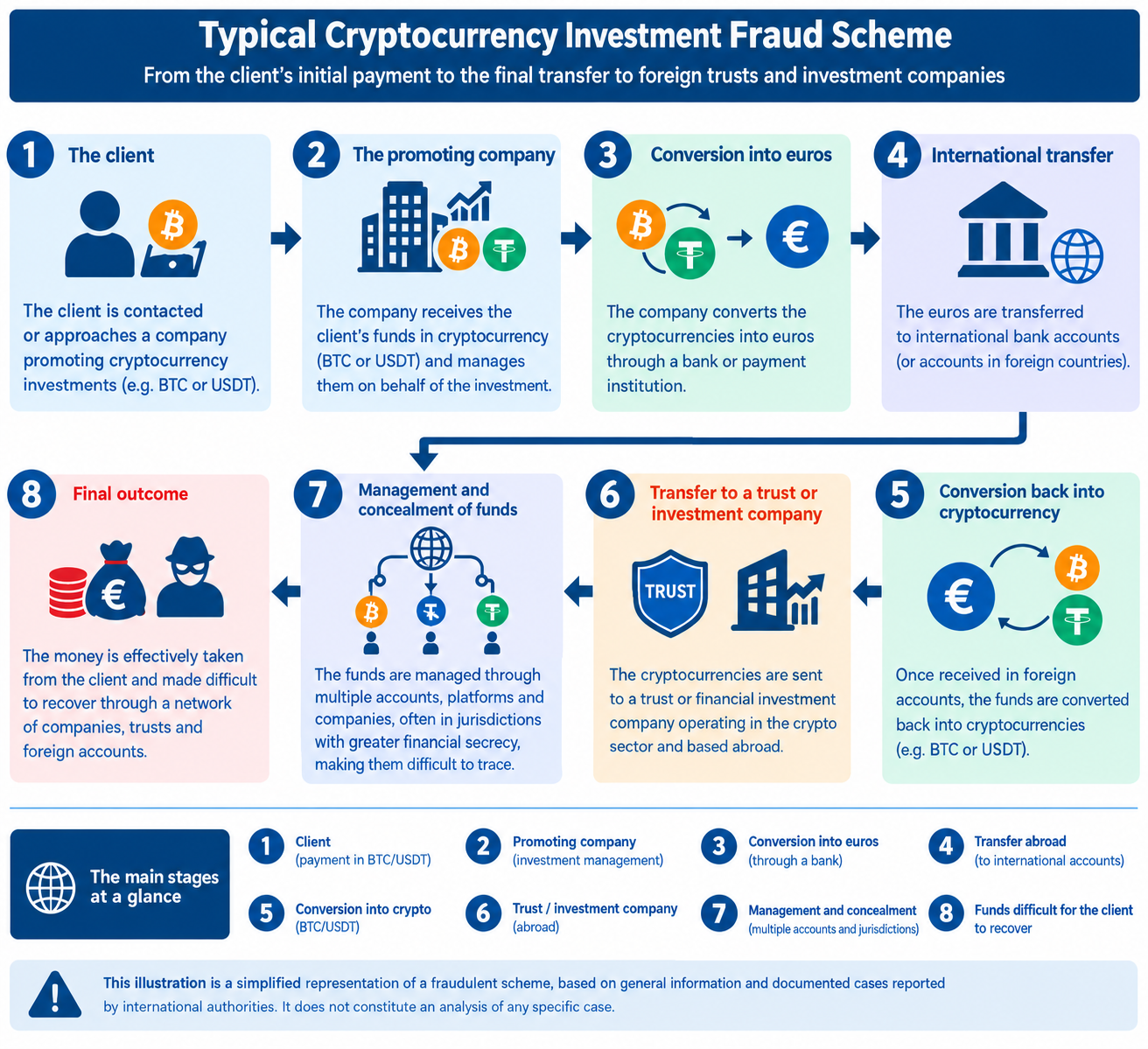
Subsequent publications document the use of online platforms, networks of intermediaries and cross-border financial transfers in fraudulent cryptocurrency investment schemes.
A particularly significant case was reported by Eurojust on 23 September 2025. The European investigation concerned an alleged fraudulent investment platform suspected of having misappropriated at least €100 million from more than one hundred victims in Germany, France, Italy, Spain and other countries.
According to Eurojust, the scheme had been operating since at least 2018 and involved 23 countries, either as the countries of residence of the victims or as jurisdictions used to transfer the proceeds. Investors were induced to participate by promises of high returns, while some of the funds were transferred to bank accounts in Lithuania. Individuals seeking to recover their capital were allegedly required to make additional payments.
This case is particularly significant for three reasons:
Financial magnitude: a single investigated scheme involved alleged losses of at least €100 million.
International scope: the victims, platforms and financial flows extended across numerous jurisdictions.
Interaction between crypto-assets and the traditional banking system: the transactions were not confined to blockchain activity but also involved conventional bank accounts.
This is a documented investigative case, not a statistical measure of the overall growth of cryptocurrency-related fraud across Europe. It must not be construed as evidence that all investment platforms or intermediaries involved in cryptocurrency transactions engage in fraudulent conduct.
Nevertheless, the case illustrates the importance of examining, where supported by the evidence, whether particular intermediaries may have failed to comply with applicable anti-money laundering and counter-terrorist financing (AML/CFT) obligations, including relevant customer due diligence, transaction-monitoring and suspicious-activity reporting requirements.
Any allegation of such a failure must be assessed individually, in light of the applicable legal framework, the obligations incumbent upon the entity concerned and the evidence available.
4. Official Data on Online Fraud: How Widespread Is the Phenomenon?
A broader indication of the prevalence of online fraud is provided by the European Union Agency for Fundamental Rights (FRA), which published survey findings on 29 May 2026 based on a survey conducted in November 2025 among 26,453 respondents across the EU.
24% — Respondents Reporting at Least One Form of Online Fraud
Approximately one in four respondents in the European sample reported having been deceived through messages or emails into transferring money, making payments or disclosing personal information.
20% — Victims of Investment Fraud
Of those respondents who reported having experienced online fraud, 20% also identified investment-related scams involving promises of financial returns.
15% — Reports to the Police
Only 15% of the victims surveyed stated that they had reported the fraud to the police.
Victims’ limited propensity to report such incidents may be attributable to several factors, including the cross-border nature of the underlying transactions, the complexity of the financial arrangements and techniques employed, the possible involvement of trusts, financial companies and other intermediaries, and the technical difficulties associated with reconstructing banking flows and blockchain transactions.
Other relevant factors may include the complexity of international judicial cooperation, the duration of criminal investigations and the technical resources required to establish the facts.
Furthermore, any potential involvement of individuals or financial institutions must be assessed with the requisite professional diligence and caution, on the basis of verifiable evidence. Equally, no individual or institution should be excluded from scrutiny solely on account of its financial standing, institutional reputation or perceived social prestige.
5. Evolution of Documented Modus Operandi
Official publications make it possible to identify a number of recurring operational characteristics. Such characteristics should not, however, be attributed automatically to every financial operator or intermediary.
5.1. Online Investment Platforms Offering Misleading Returns
Fraudulent investment schemes may rely on online platforms that advertise attractive or purportedly guaranteed returns in order to induce individuals to transfer funds.
5.2. Manipulation of Victims into Authorising Payments
Fraudsters may manipulate victims into authorising payment transactions, including through impersonation, social engineering and deceptive communications.
5.3. Transfers Between Bank Accounts and Crypto-Assets
Fraudulent schemes may involve the movement of funds between traditional bank accounts, cryptocurrency exchanges and blockchain-based wallets, thereby requiring the reconstruction of both conventional financial transactions and on-chain transfers.
5.4. Corporate Networks and Accounts Located in Multiple Jurisdictions
Investigated schemes may involve corporate structures, intermediaries and bank accounts distributed across several countries, potentially complicating the identification of beneficial owners, the tracing of proceeds and the establishment of the parties exercising effective control over the relevant assets.
5.5. Additional Payments Demanded as a Condition for Recovering Investments
A further documented warning sign is the demand for additional payments from victims seeking to recover their original investment or withdraw funds allegedly held on an investment platform.
5.6. The Use of Artificial Intelligence in Online Fraud
Artificial intelligence may facilitate increasingly sophisticated online scams, including deceptive communications and other forms of financial manipulation.
These operational characteristics may overlap within a single scheme. Their evidential significance must be assessed in the context of the particular transactions, contractual relationships, communications and financial flows under examination.
6. The Cross-Border Dimension
The international dimension is one of the most significant aspects of financial fraud affecting European victims.
An investment may be marketed through a platform accessible from Italy, funded through bank accounts located in another Member State and involve companies or financial service providers established in additional jurisdictions.
The investigations cited above demonstrate that such arrangements have arisen in actual cases investigated by European authorities. In cases of this nature, the involvement of multiple jurisdictions may necessitate coordinated information requests, the identification of the persons exercising control over relevant accounts and the reconstruction of transfers between banking systems, payment service providers and cryptocurrency exchanges.
The Eurojust case reported in 2025 illustrates the importance of judicial cooperation and the use of asset-freezing measures in cross-border investigations.
From an investigative perspective, the analysis should distinguish between the mere involvement of a particular institution in a transaction and evidence that the institution, or individuals acting on its behalf, participated in unlawful conduct or failed to discharge specific legal obligations.
Where the evidence warrants further examination, relevant lines of inquiry may include the identification of beneficial owners, the verification of customer due diligence procedures, the assessment of transaction-monitoring controls and the reconstruction of the movement of funds across the various entities involved.
7. Conclusions: Findings That Can Be Supported Without Overstating the Evidence
On the basis of the publicly available sources examined, the following conclusions can be stated with a reasonable degree of confidence.
First, payment fraud has experienced a documented recent increase in financial value. Within the European Economic Area, the reported value of fraudulent payment transactions rose from €3.4 billion in 2022 to €4.2 billion in 2024.
Second, cryptocurrency-related investment fraud is a recognised risk documented by European authorities. Europol and Eurojust have reported cases involving substantial alleged losses and victims located in numerous countries.
Third, banking fraud and cryptocurrency-related fraud may form part of the same operational chain. Funds may move from online investment platforms into bank accounts and subsequently to other intermediaries or crypto-assets. An adequate investigation may therefore require the combined analysis of banking records, payment data, corporate structures and blockchain transactions.
Fourth, online fraud represents a significant concern within the European population. According to the FRA survey conducted in 2025 and published in 2026, 24% of respondents reported having experienced online fraud.
Fifth, the available statistical series do not support a single, reliable percentage increase in cryptocurrency-related, financial and banking fraud across the entire 2016–2025 period. Any such conclusion would require annual data that are sufficiently comparable in terms of definitions, geographical coverage, case numbers and financial values.
Accordingly, the most defensible conclusion is that official European sources document substantial financial losses, the persistence of investment-related scams, the increasing operational complexity of certain schemes and the importance of cross-border cooperation in investigating financial crime. The precise magnitude of the overall increase during the decade, however, cannot be established rigorously from the statistical series identified in this analysis alone.